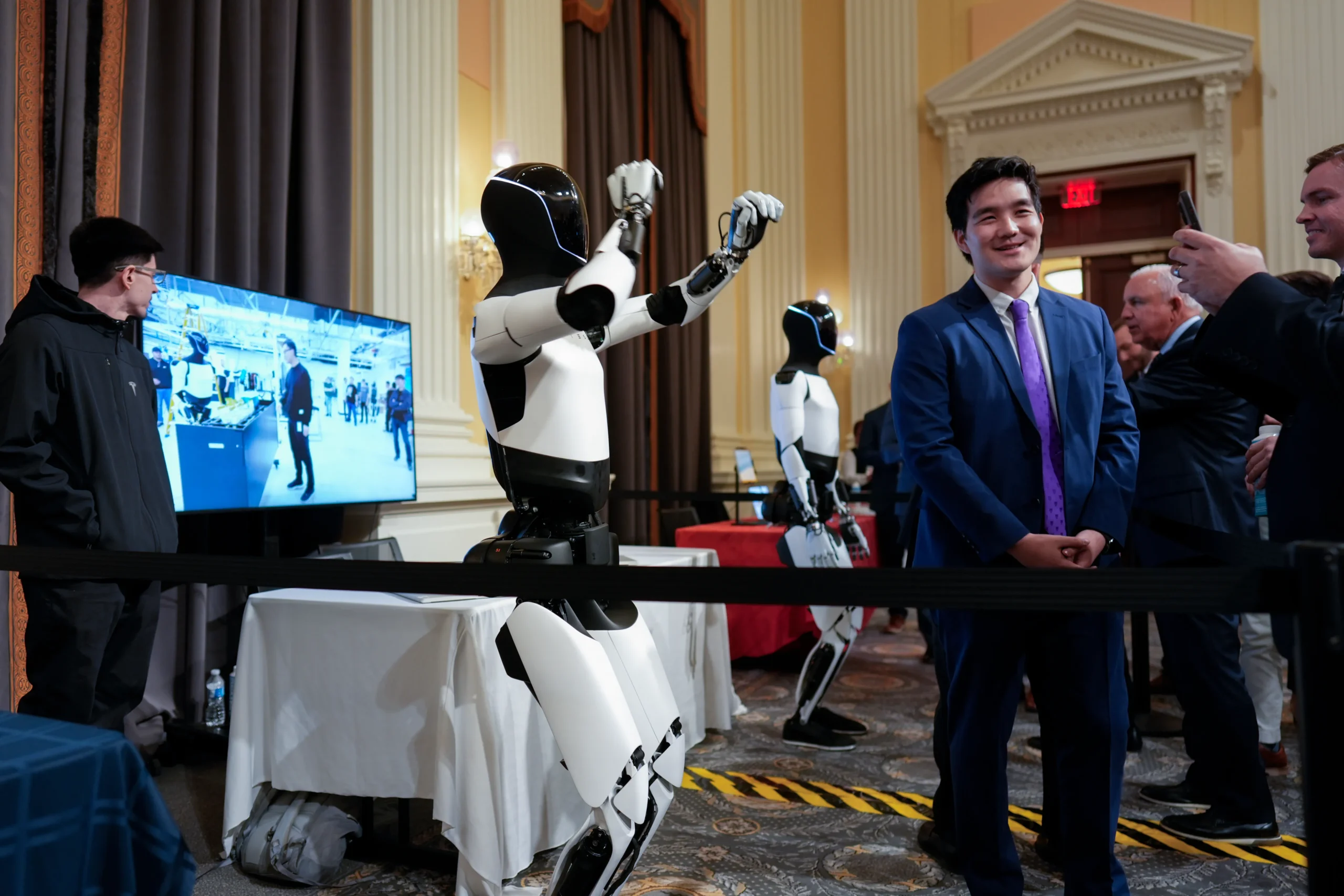
Congress Wants to Keep China Out Congress has just drawn the most direct line yet in the robotics contest between the US and China. In the first week of June 2026, bipartisan lawmakers introduced two separate robotics bills at once: one to build a national robotics strategy from the bottom up, and one that could effectively ban Chinese-made robots from US soil.
The National Commission on Robotics Act would create an 18-member commission to assess US competitiveness in robotics and make recommendations on workforce development, supply chains, manufacturing, research and national security.
The GUARD Act would require federal agencies to review humanoid and quadruped robots made by China and other designated foreign adversaries, with systems deemed national security risks potentially barred from deployment in the United States. Here’s what each bill does and why the timing matters.
The GUARD Act: Chinese Robots Could Be Banned From the US Market
Backdoors, Espionage Risks, and One Chinese Company in the Crosshairs
The Guarding the US Against Adversarial Robotics Dominance Act was introduced by Republican Reps. John Moolenaar of Michigan and Jay Obernolte of California, alongside Democratic Rep. Jennifer McClellan of Virginia.
It would require national security agencies to begin a review process for any humanoid and quadruped robots made by China or other designated adversary countries. Those deemed a national security threat would be placed on the Federal Communications Commission’s Covered List, effectively banning them from use in the US.
The security concern being raised isn’t vague or hypothetical. “Robots made by China are a threat to national security, critical infrastructure, and American workers. They contain backdoors that can be hijacked for espionage, and our legislation will stop these threats now before China can embed them throughout America,” said Rep. Moolenaar.
The legislation directs US national security agencies to assess whether foreign-made robotic systems could be exploited for espionage, data collection, or other activities harmful to American interests. Products not reviewed within a year would automatically face restrictions.
The lawmakers specifically targeted Unitree, a China-based robotics firm that critics note has extensive ties to the Chinese military. Tekedia
What makes this different from previous tech restrictions is the breadth of the market it covers. These robots aren’t just being sold to government agencies. They’re showing up in university research labs, startup warehouses, and consumer living rooms.
The National Commission on Robotics Act: Building a Strategy America Doesn’t Have Yet
China Has a National Robotics Plan. South Korea Has One. The US Doesn’t.
The second bill tackles a different problem, and in some ways, a more fundamental one. The US has been the world’s most innovative robotics market for decades. But it has never had a coordinated national strategy to match that innovation with direction, investment, and competitive intent.
Rep. Jay Obernolte, who chairs the relevant House panel, stated the US needs to adopt a national robotics strategy to counter China’s ambitions and embolden domestic manufacturing and workforce adoption of robots. He noted that China and US allies like South Korea and Japan already have their own strategies, adding that “there’s such an obvious linkage between a robotics strategy and our national economy and national security.”
The proposed commission would examine the competitiveness of the domestic robotics industry, workforce development needs, supply chain risks, foreign robotics policies, and opportunities for collaboration among industry, government, and academic institutions. The group would be required to deliver an interim report within one year and a final set of recommendations within two years. TipRanks
The Senate is moving in parallel. Introduced by Senators Tom Cotton and Chuck Schumer, the American Security Robotics Act would prohibit executive agencies from procuring or operating unmanned ground vehicle systems manufactured or assembled by covered foreign entities. Representative Elise Stefanik has introduced companion legislation in the House, signaling that concerns about robotics systems manufactured by certain foreign entities are not confined to a single chamber or party.
Why These Bills Are Landing Now: The China Surge Is Real and It’s Fast
State Capital, AI-Powered Humanoids, and an EV Supply Chain Ready to Scale
The timing of this legislative push isn’t political theater. It’s a direct response to something measurable that has been accelerating for 18 months.
Beijing continues to invest heavily in both humanoid and industrial robotics as an emerging global industry and economic necessity amid a rapidly aging population. Relying on supply chains developed for electric vehicles and drones and supported by state investments, Chinese firms remain early leaders in humanoid robots despite struggles domestically sourcing advanced semiconductors subject to US export controls.
Robotics companies tied to the Chinese Communist Party and the Chinese military are increasingly selling their products to American research labs, universities, law enforcement agencies, and even targeting consumers purchasing robots for personal use. Robotics & Automation News
That last point is what converted this from a defense procurement debate into a broader national security and consumer protection conversation. When robots with potential backdoors are being marketed directly to individual consumers, the threat surface is no longer confined to government facilities.
Conclusion: The Robotics Race Has Officially Become a Geopolitical Race
The introduction of two separate robotics bills in the same week, with bipartisan support across both chambers, is not a coincidence. It is a coordinated legislative signal that robotics has joined semiconductors, drones, and telecommunications on the list of technologies where Washington believes US leadership is a national security requirement, not just an economic preference.
“We can and still must lead in the field of robotics, but to achieve that goal, we need a concerted national effort to support innovation across the full robotics system,” said Rep. Zoe Lofgren of California.
Whether you’re a robotics company, a business evaluating robotic deployment, or an investor tracking the sector, these bills represent the clearest signal yet that the US regulatory environment for robotics is about to change fundamentally. Track both bills as they move through committee. The outcomes will determine the competitive landscape for the entire global robotics industry for the next decade. Stay informed and stay ahead.