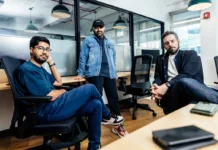
Amazon doesn’t usually make headlines for backing niche AI research labs. So when it joins a $310M Series B in Palo Alto startup Odyssey, at a $1.45 billion valuation, that’s worth paying attention to.
This isn’t just a funding story. It’s a signal about where the entire AI industry is heading next.
Amazon’s Big Bet on World Model AI
Most people know Amazon for cloud services and next-day delivery. But quietly, AWS is building an AI chip empire to rival Nvidia, and it just found its showroom car.
Alongside the investment, Amazon and Odyssey announced that AWS will become Odyssey’s preferred cloud provider. That means training Odyssey’s notoriously compute-heavy world models on Amazon’s own Trainium chips.
Why Trainium Needs a Win Like This
Nvidia still dominates AI compute by a wide margin. Amazon’s Trainium chips are capable, but they need high-profile customers running serious workloads to prove themselves at scale.
World models are nearly ideal for that. They demand massive throughput, tight latency, and real-time physics rendering – exactly the kind of stress test that turns a chip from a spec sheet into a credibility statement. For Amazon, Odyssey is a reference customer. For Odyssey, it’s discounted compute at scale.
Who Built Odyssey – and Why That Matters
CEO Oliver Cameron co-founded autonomous vehicle startup Voyage, which General Motors’ Cruise later acquired, where he became VP of Product. CTO Jeff Hawke came from Wayve, a buzzy UK self-driving startup.
Both founders spent years solving what many consider the hardest prediction problem in AI: anticipating everything a moving vehicle might encounter – pedestrians stepping off curbs, cyclists swerving, weather turning – millisecond by millisecond.
From Roads to Reality
That experience shaped Odyssey’s core conviction. If an AI can learn cause and effect on a highway, it can learn it anywhere. The founders didn’t just pivot into world models – they built toward them from day one.
Their research reflects that. Odyssey-2 Max sharpened physics accuracy. Starchild-1 introduced real-time multimodal simulation. Agora-1 put multiple AI agents inside one shared simulated world. Each project is a brick in something bigger: a foundation model for physical reality.
The Investor List Tells Its Own Story
Natural Capital led the round. Amazon, AMD Ventures, Alphabet’s GV, EQT, and CIA-affiliated In-Q-Tel all joined. On the angel side: Jeff Dean (Google’s chief scientist), Kyle Vogt (Cruise founder), Garry Tan (Y Combinator CEO), and Vercel’s Guillermo Rauch.
That’s not a typical seed-stage bet. That’s a who’s who of people who’ve built foundational technology before and believe world models are next in line.
Notably, Nvidia’s venture arm backed Odyssey’s Series A just four months earlier. The pivot to AWS this round sends a pointed message about where the compute wars stand.
Conclusion – A Turning Point for AI
The language model era isn’t over. But Odyssey’s $310M raise signals that serious money is already moving toward what comes next: AI that understands space, physics, and time – not just sentences.
Whether you’re in robotics, gaming, healthcare, or defense, world models are coming for your industry. This funding round just moved the timeline closer.
Want the full picture on physical AI funding? Explore our breakdown of XDOF’s $70M robotics infrastructure raise to see how the two stories connect.