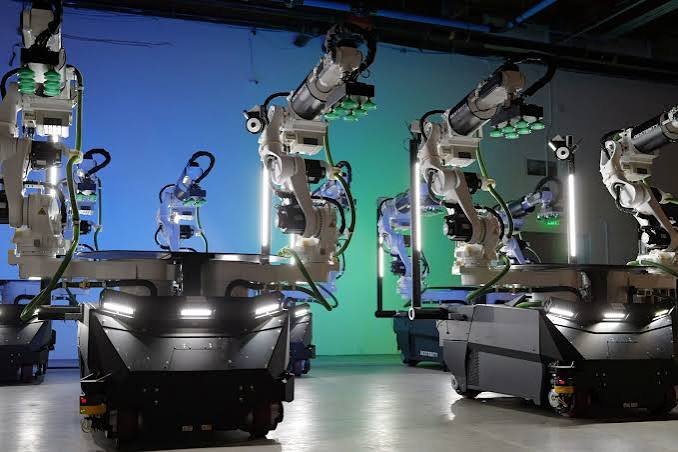
The warehouse floor has always been one of automation’s toughest rooms. Boxes arrive in the wrong size, at the wrong angle, and sometimes just fall over. Kawasaki Robotics and Dexterity just announced an expanded collaboration that’s specifically built for that messiness – and it’s already running in real logistics environments.
The partnership centers on Kawasaki’s new RL030N robot arm and Dexterity’s Mech super humanoid robots, and the timing is deliberate: the announcement dropped at Automate 2026 in Chicago this week.
The Robot Arm That Warehouses Actually Need
The RL030N is the industry’s first 8-axis robot designed specifically for Physical AI applications. It combines high-speed motion, enhanced dexterity, lightweight construction, and real-time external orchestration capabilities for dynamic and confined environments.
That extra axis isn’t a spec sheet gimmick. Logistics operations are more variable than factory settings: packages arrive in different sizes, weights, shapes, orientations, and conditions; boxes shift, fall, deform, and stack unpredictably; and contact with packages, containers, conveyors, walls, or surrounding equipment is part of normal operation.
Built From the Ground Up With Dexterity
This wasn’t a case of an off-the-shelf arm being retrofitted for a new application. Dexterity’s Mech design and warehouse logistics requirements shaped the arm; Kawasaki Robotics and Kawasaki Heavy Industries brought precision engineering and manufacturing expertise to turn those requirements into a production-ready 8 DoF robot arm platform.
That’s a meaningful distinction. Most industrial robot arms were engineered for factory floors first and adapted later. The RL030N started from the warehouse problem and worked backward, which is why it’s lighter, more articulated, and built for the kind of unavoidable contact that would destroy a conventional arm’s repeatability ratings.
How the Foresight World Model Ties It Together
Hardware is only half the story. The RL030N is powered by Kawasaki Robotics’ open KRNX real-time control API, enabling external AI software, ROS environments, machine learning systems, vision platforms, and third-party orchestration systems to directly control the robot in real time.
Dexterity layers its Foresight World Model on top of that open control interface. Together, the two systems give the Mech robot something conventional automation never had: the ability to anticipate what a box is about to do, not just react after it shifts.
Why This Matters for Trailer Loading
Dexterity SVP Keshav Prasad put the challenge plainly: packages vary, boxes move unpredictably, and contact is part of the job. By combining RL030N with Foresight World Model, Mech hardware, and Dexterity’s production software stack, the companies can bring Physical AI into warehouse operations where traditional automation has not been able to scale.
Trailer loading is one of the most physically demanding, injury-prone jobs in logistics. It also happens to be one of the hardest to automate. That’s exactly where Dexterity is focusing first.
Automate 2026 as the Launching Pad
At Automate 2026, Kawasaki Robotics is showcasing the RL030N as an 8 DoF robot arm platform built for dynamic and confined environments. Together, Kawasaki Robotics and Dexterity are highlighting how advanced robot arms, real-time control interfaces, enterprise Physical AI software, and production-scale Mech systems can unlock new categories of industrial automation.
Kawasaki president Seiji Amazawa framed the company’s broader philosophy at the show: the future of automation will be defined by robotic systems that seamlessly integrate perception, motion, and decision-making. The Dexterity partnership is the clearest live demonstration of that thesis.
Conclusion – When Old Industry Meets New AI
Kawasaki has been building industrial robots since 1969. Dexterity was founded in the AI era, with a software-first mindset and a world model at its core. This collaboration is what happens when those two things meet in the middle – and warehouses are the first place to feel it.
Physical AI for logistics is no longer a pilot-program concept. With production scaling underway and real deployments running, the question for warehouse operators isn’t whether this technology works. It’s how quickly they can get it on their floor.