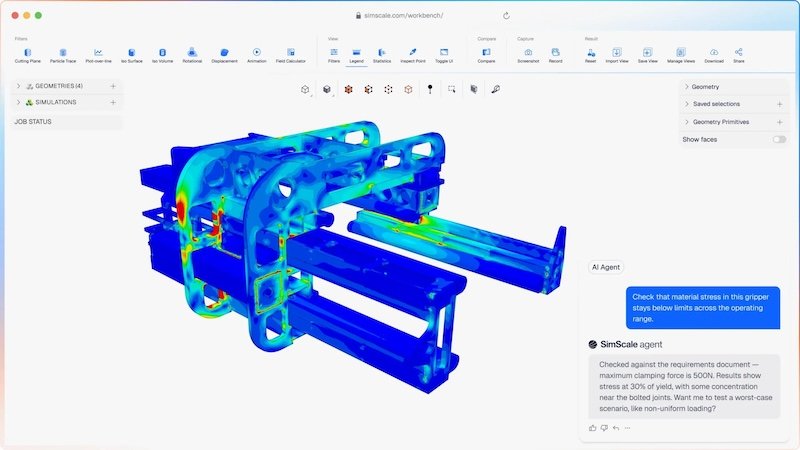
Building a robot for a real warehouse is nothing like building one in a lab. The machine has to extend to twelve metres, navigate forklifts, scan 12,000 pallets an hour, and do all of it reliably without a single failure that shuts down a customer’s operation. Dexory, the UK-based autonomous warehouse intelligence company, is now using SimScale’s Engineering AI platform to compress that development challenge – simulating design decisions in the cloud before any physical prototype gets built.
The collaboration positions SimScale as an infrastructure layer inside Dexory’s hardware development pipeline, bringing cloud-native CFD, FEA, and thermal simulation into a field where reliability isn’t a feature – it’s the product.
Why Warehouse Robots Are a Brutal Engineering Problem
Dexory’s autonomous robots are not simple machines. The new robot operates safely alongside people and machinery without disrupting daily workflows. It captures high-frequency warehouse data and continuously feeds a live view of operations into Dexory’s digital twin platform, DexoryView. With an extended scanning range of up to 60 feet, the robot can process more data, faster, delivering consistent visibility across racks of all shapes and sizes, including double-deep configurations, block storage, and other non-racked environments.
That kind of performance envelope requires engineering decisions that traditional prototype-and-test cycles handle poorly. Structural loads change as the tower extends. Thermal conditions vary across warehouse environments. And every kilogram of unnecessary mass costs speed and battery life.
Simulation Before Steel
Instead of waiting for a prototype to fail on the bench, the strongest robotics teams are finding the failure in simulation first, while the design is still cheap to change. Cloud-native CFD, FEA, and thermal simulation now let an engineer test a structural variant, a cooling strategy, or a resonance risk in hours, from a browser, without an HPC queue or a dedicated simulation department.
That’s the core value proposition SimScale brings to Dexory’s workflow. Rather than committing to physical builds to validate structural assumptions, Dexory’s engineering team can run multiple design variants simultaneously in the cloud and arrive at each prototype decision already informed by physics.
Engineering AI Changes the Economics of Hardware Development
SimScale’s platform has evolved well beyond a simulation tool. Engineering AI orchestrates the setup that used to gate every study: importing the CAD assembly, meshing it, applying loads and boundary conditions, and building the parametric sweeps.
For a robotics team under commercial pressure, that matters enormously. Setup time was the hidden cost of simulation – skilled engineers spending hours configuring models before a single result came back. Engineering AI compresses that to minutes, which means a team can run 80-plus structural variants across a development program rather than the handful that traditional workflows allowed.
Physics AI Accelerates the Design Space Search
Physics AI learns from high-fidelity results and then predicts new variants in near real time. Instead of running expensive flow and structural solvers on every design candidate, you solve a baseline set, train a model, and let Physics AI screen the rest of the design space in seconds.
For Dexory, that capability is directly applicable to challenges like tower stiffness optimization, scanner mounting geometry, and electronics thermal management – all areas where exploring many design variants quickly translates into a better, lighter, more reliable robot.
What SimScale Brings That Legacy Tools Don’t
SimScale pointed to prior collaborations with partners like Dexory and QPT to extend AI-driven design and cloud simulation into logistics, power electronics, and consumer products.
The platform’s cloud-native architecture is the differentiator that makes this practical for a company like Dexory. There’s no HPC infrastructure to maintain, no simulation department to staff, and no VPN required. Engineers can run structural impact simulations, resonance analyses, and thermal models in parallel from a browser – exactly the kind of broad, fast iteration that lets a hardware startup stay lean while making engineering decisions that used to require much larger teams.
Cloud compute scaled to the work. Eighty-plus chassis runs, multiple designs compared side by side, twenty cooling simulations at once – none of it required a workstation per engineer or a queue for shared HPC.
Conclusion – Simulation Is Now Warehouse Robotics Infrastructure
The warehouse robotics market is moving fast. Dexory has raised a total of $205M over 14 rounds, and with a Nashville HQ now open and customers including GXO, Maersk, and DHL, the pressure to ship reliable, high-performance hardware at scale is real.
Using SimScale’s Engineering AI isn’t a research experiment for Dexory – it’s a development infrastructure decision that affects how quickly the next robot generation reaches customers and how confident the team can be in its performance before it leaves the lab. In a market where getting a robot wrong means a failed deployment at a tier-one logistics customer, that confidence is worth more than the time it saves.
Want to see how other physical AI companies are solving the data side of the same hardware challenge? Read our breakdown of XDOF’s $70M robotics training data raise to see how the simulation and data infrastructure stories connect.