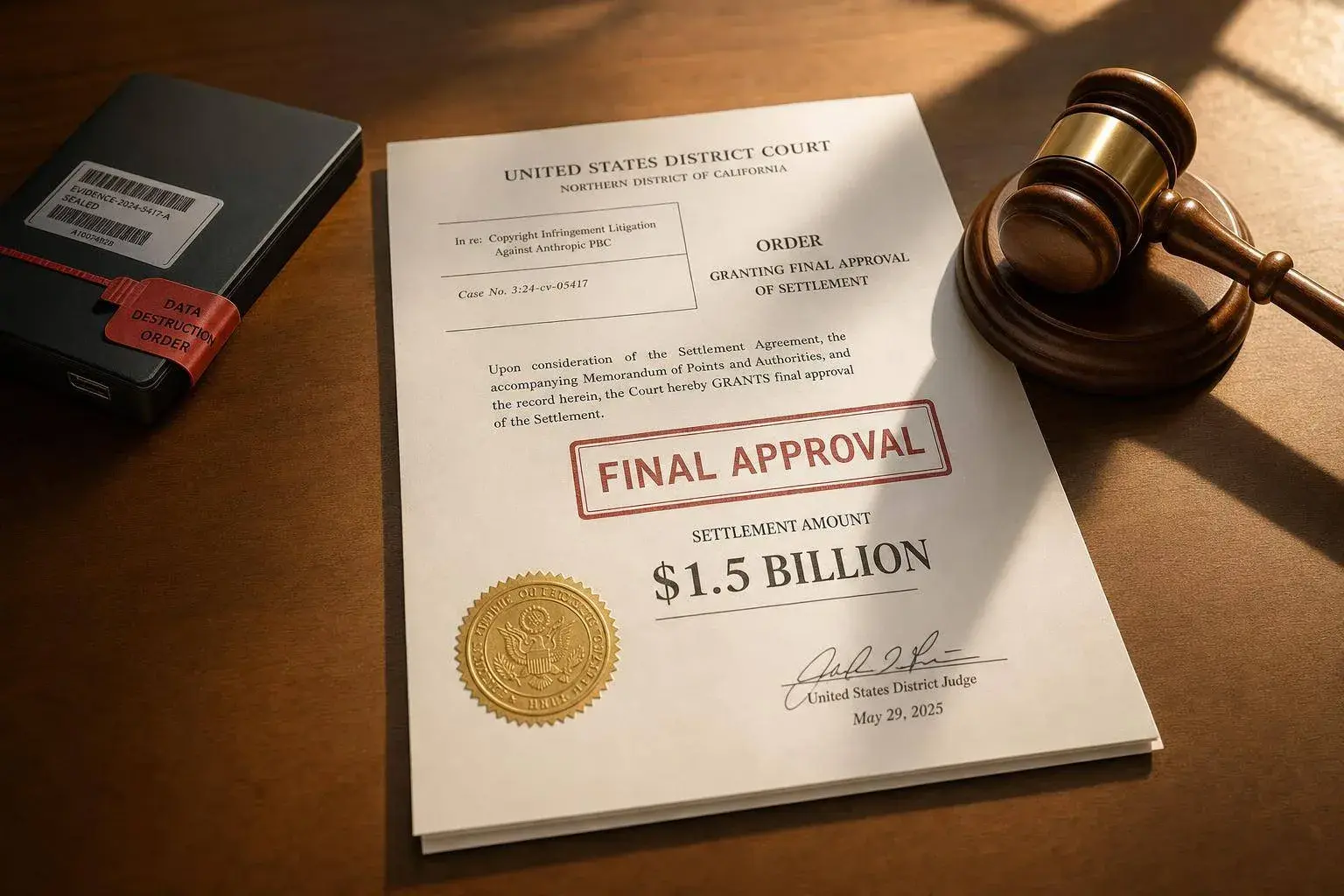
It’s the largest copyright payout in American legal history, and it just became official. A federal judge gave final approval to Anthropic’s $1.5 billion settlement with authors and publishers whose books were used to train its Claude AI chatbot – closing out a case that has reshaped how the AI industry thinks about intellectual property.
Judge Araceli Martinez-Olguin signed off on the settlement on Monday, after the original presiding judge, William Alsup, had retired following his preliminary approval. The ruling draws a line under one chapter of AI copyright law – while leaving the larger legal questions very much open.
What the Settlement Actually Pays Out
The payout will deliver $3,000 per work across an estimated 500,000 works, shared among the authors and publishers who hold rights to them. That’s a straightforward number on paper, but the math behind it involves significant deductions.
The settlement spurred objections from some authors who argued it was not large enough, overcompensated the plaintiffs’ attorneys, or wrongly excluded some copyright owners. Judge Martinez-Olguin overruled those objections in her ruling on Monday.
Attorney Fees and Author Reactions
The court approved more than $101 million of the $187.5 million in fees requested by attorneys – a figure that drew criticism from some class members. The judge said that complaints about the settlement’s size were “not grounded in a realistic assessment of the overall risks and rewards of a trial.”
Authors’ lead attorney Justin Nelson called it a historic settlement, describing it as the largest known copyright recovery in history. Anthropic deputy general counsel Aparna Sridhar noted that more than 91% of authors and publishers covered by the settlement had already claimed their share.
The Narrow Legal Finding That Drove the Settlement
The lawsuit didn’t end the way most people expected. The original judge actually ruled in Anthropic’s favor on the central copyright question – finding that training AI on books constitutes fair use under copyright law.
The settlement was driven by something narrower and considerably more damaging. Judge Alsup found that Anthropic had illegally downloaded and stored millions of copyrighted books – specifically, that the company used shadow libraries like LibGen and then systematically acquired and destroyed thousands of used books to scan into its own digital library, saving over 7 million pirated books to a “central library” that would not necessarily be used for training purposes.
Why Anthropic Chose to Settle
A trial was scheduled to begin in December to determine how much Anthropic owed for the alleged piracy, with potential damages running into the hundreds of billions of dollars. That exposure, not the fair use question, is what put a $1.5 billion check on the table.
As Cornell Law Professor James Grimmelmann put it, storing pirated books was a narrow issue – but financially very dangerous for Anthropic, making the company highly incentivized to resolve it.
What This Doesn’t Settle
The approval closes this specific case. It doesn’t close the broader legal debate. While the settlement is believed to be the largest in the history of U.S. copyright law, many authors and creators still don’t view it as a win.
Critically, Alsup’s ruling was a single district court decision, and Anthropic’s decision to settle means the case will never reach an appeals court to become binding precedent. Other judges are still free to reach their own conclusions on their own facts, which is exactly what’s playing out elsewhere.
Google, Meta, Midjourney, and OpenAI all face active copyright lawsuits – each with their own facts, their own judges, and potentially their own conclusions. Key legal questions about copyright and how AI companies are using human-made content remain unresolved.
Conclusion – A Record Check, Not a Final Answer
This settlement is the first big one, but just one of many lawsuits still pending. The AI industry has its first landmark copyright resolution – and a clear signal that building training datasets from shadow libraries carries serious financial risk regardless of how fair use arguments land.
For authors, it’s a payment with caveats. For AI companies, it’s a cautionary tale about how data is sourced. For the legal system, the hardest questions are still waiting for a courtroom that will see them through to appeals.
Want to understand the broader landscape of AI regulation and legal accountability? Read our breakdown of Nobel laureates’ urgent call on AI’s economic impact to see the policy conversation shaping the industry’s future.