Astronauts spend about a third of their time on routine maintenance tasks. Moving cargo, clearing trash bags, shifting equipment around a cramped cabin – work that’s necessary but hardly the reason anyone signs up to go to space. Rice University and NASA Johnson Space Center just released a tool that could hand much of that work to robots instead.
The iMETRO Dynamic Simulation is the world’s first open-source dynamic simulation environment for intravehicular space robotics – and it debuted this month at the 2026 IEEE International Conference on Robotics and Automation in Vienna.
What the iMETRO Simulator Actually Is
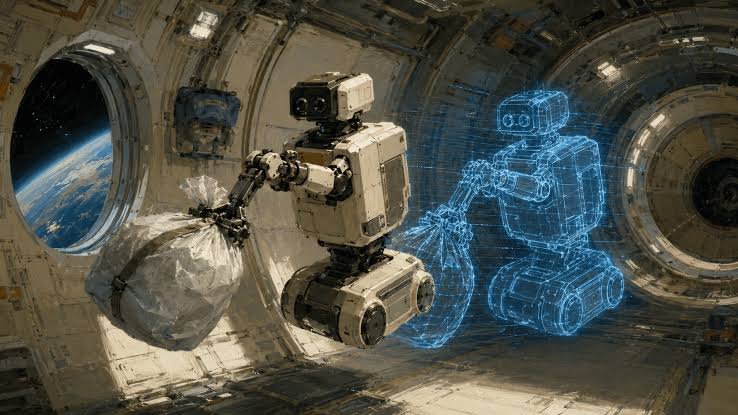
The simulator is a digital twin of NASA Johnson’s iMETRO facility – a physical test bed with full-scale mockups of future space vehicles and lunar habitats, along with custom robotic platforms. Researchers anywhere in the world can use it to design, test, and validate robot software before touching a single piece of physical hardware.
A Same-Day Transfer From Simulation to Real Hardware
That gap between simulation and reality is usually where robotics projects stall. Testing in software is one thing. Getting the same code to run on actual hardware, in a real facility, without breaking, is another thing entirely.
The Rice-NASA team closed that gap dramatically. Researchers were able to move a newly developed application from the simulation environment to the NASA Johnson facility and have it operating in less than a day. For a field where integration testing can take weeks or months, that’s a genuinely different pace.
The Problem Space Robots Have to Solve
Earth robots have it comparatively easy. They work in fixed environments, with predictable gravity, standard lighting, and surfaces that behave consistently. Space habitats are a different problem.
Space habitats create manipulation challenges that differ from Earth-based settings, including low- and zero-gravity conditions. The broader robotics community has lacked accessible open-source tools for simulating those conditions and testing robot behaviors for space interiors.
Freeing Astronauts for What Actually Matters
Crew members spend about a third of their time on routine maintenance work, including moving trash bags or cargo from resupply capsules. That’s not a minor inefficiency – on a long-duration mission to the Moon or Mars, it’s a meaningful chunk of the total time available for science and exploration.
Robots that can reliably handle interior logistics don’t just save astronaut effort. They fundamentally change what a small crew can accomplish across a multi-year mission. That’s the real payoff the iMETRO program is building toward.
Open Source as a Force Multiplier
The decision to release this as an open-source platform was deliberate, and it matters. Before iMETRO Dynamic Simulation, a researcher at a university in Germany or a robotics lab in Japan had no practical way to test their ideas against realistic space habitat conditions without travelling to NASA’s physical facility.
Now they don’t have to. As Rice Professor Lydia Kavraki noted, by developing a full-featured, high-fidelity dynamic simulation of a NASA space operations test facility, this new modeling tool makes space robotics research accessible to the global robotics community.
That openness compounds over time. Every research team that builds on iMETRO, tests an idea, and publishes results raises the collective knowledge base for everyone working on the same problem. It’s the same dynamic that made the open-source software ecosystem so productive – applied to one of engineering’s hardest operating environments.
The project was funded by the NASA Johnson Space Center Engineering Innovation Fund, the Ken Kennedy Institute at Rice University, Rice University’s School of Engineering and Computing, and the U.S. National Science Foundation.
Conclusion – The Orbital Maintenance Crew Is Coming
Space robotics has always been a field where progress moves in slow cycles – expensive hardware, limited access, long testing timelines. The iMETRO Dynamic Simulation breaks several of those constraints at once.
Researchers worldwide can now prototype, test, and validate space-ready robotic software without leaving the ground – and get it running on real NASA hardware in under a day. That’s the kind of infrastructure shift that quietly compresses a decade of development into a much shorter window.
The astronauts of the next generation may spend a lot less time hauling cargo. There’s now an open-source platform helping build the robots that’ll do it for them.
Want to see how open-source robotics tools are changing development on Earth too? Read our breakdown of Nvidia and Hugging Face’s LeRobot integration to see the same philosophy applied to physical AI at scale.