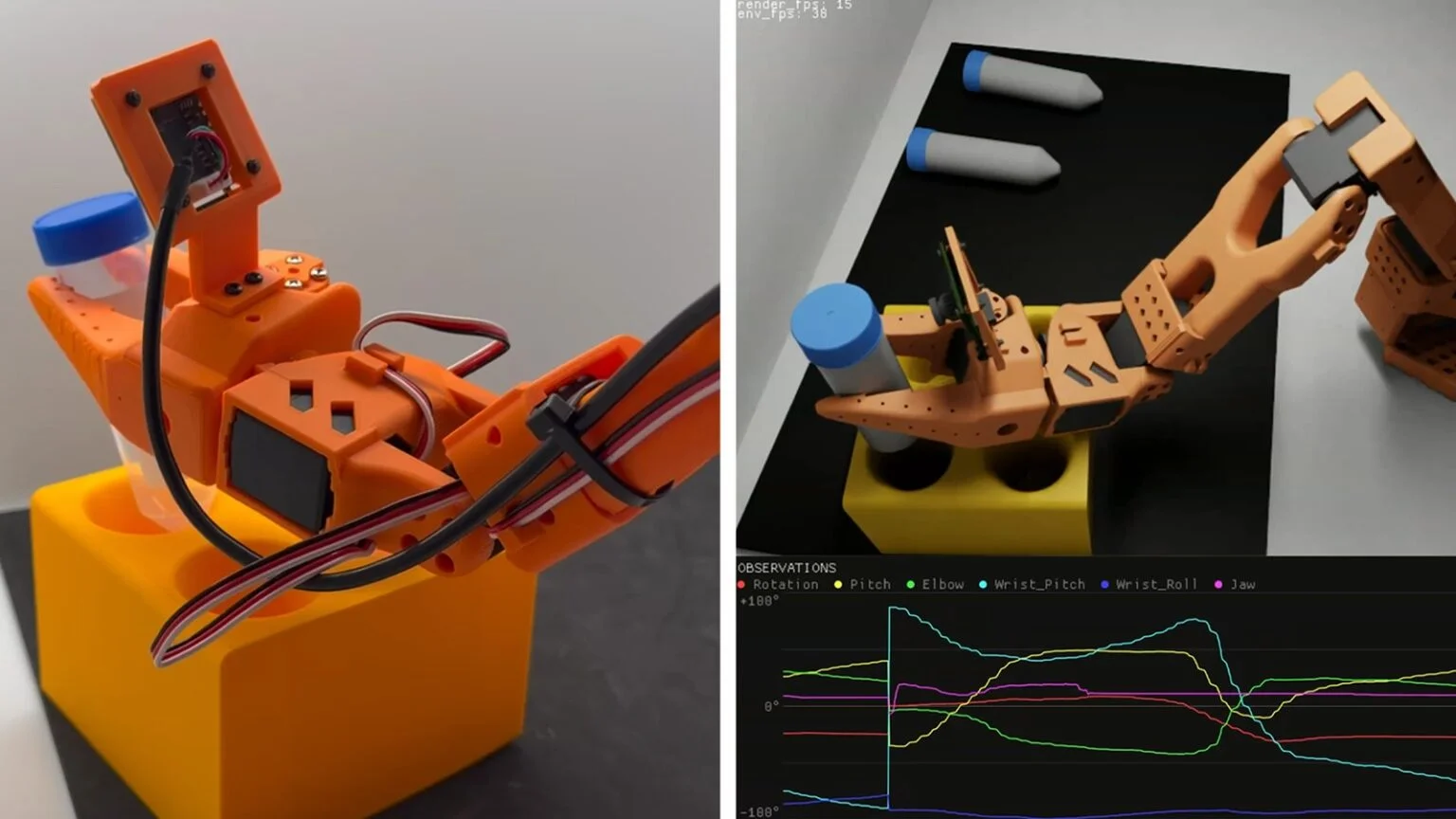
Two of AI’s biggest names just decided that the best way to win the robotics race isn’t to build everything behind closed doors. Nvidia and Hugging Face are integrating Nvidia’s core robotics tools directly into LeRobot – Hugging Face’s open-source library for physical AI developers – and the potential reach is staggering.
The collaboration connects Nvidia’s 3 million robotics developers with Hugging Face’s 16 million AI builders. That’s not a partnership announcement. That’s a community merger.
What’s Actually Landing Inside LeRobot
The headline integrations are immediate and concrete. Isaac Teleop, an open-source framework for collecting robot training data from human demonstrations using standardized formats, is now available inside LeRobot. So is Isaac GR00T 1.7, Nvidia’s open vision-language-action model for humanoid robots – the one developers can post-train and deploy through standard LeRobot workflows.
The Cosmos 3 Integration Is Still Coming
World foundation model Cosmos 3 is planned for LeRobot and would support data generation, simulation and policy development when real-world data is limited or expensive to collect. That last part matters enormously. Real-world robot training data is slow, costly, and logistically painful to collect. A world model that can generate synthetic data at scale doesn’t just speed things up – it changes the economics of the entire field.
Think of it as the difference between needing a warehouse and 20 teleoperators to train a new robot behavior, versus running millions of simulated trials overnight.
What Already Existed in LeRobot Before This
The Nvidia integrations land on top of a platform that was already well-stocked. LeRobot is connected to an open-source physical AI dataset with more than 350,000 real and simulated trajectories and 57 million grasps, along with Isaac Sim and Isaac Lab simulation frameworks for setting up environments, generating robot data, testing policies and validating behaviors before using physical robots.
From Prototype to Deployment in One Ecosystem
Isaac Lab-Arena in the LeRobot Environment Hub lets developers prototype simulation environments and use them in the LeRobot ecosystem, while Jetson Thor integration with LeRobot’s Reachy 2 supports deployment of vision-language-action models on open-source humanoid robots.
That’s a meaningful end-to-end pipeline: simulate an environment, collect demonstration data, train a model, fine-tune it, evaluate performance, and deploy – all inside one open framework. Until recently, stitching those steps together meant switching between incompatible tools from different vendors with different data formats. LeRobot with Nvidia’s additions collapses that stack.
Why Open Source Is the Right Move Here
Hugging Face co-founder and Chief Science Officer Thomas Wolf was direct about the reasoning behind the collaboration: open source is how a field turns advanced research into something people can study, adapt, and build on.
That’s not just an ideological position – it’s a growth strategy that worked spectacularly well for large language models. The open-source NLP ecosystem that grew up around Hugging Face’s early tools helped the whole field move faster, which eventually raised the ceiling for everyone, including the companies that also have proprietary offerings.
Physical AI is at roughly the same stage language AI was in 2019. The open-source infrastructure that gets built in the next two to three years will probably determine which platforms developers default to for the decade after that. Nvidia and Hugging Face appear to understand that window.
The scale of what’s already on the platform reinforces the point. More than 350,000 training trajectories, 57 million grasps, and now Nvidia’s full robotics stack – all openly accessible to any developer with a robotics project, from a university lab to a startup to a Fortune 500 research team.
Conclusion – The Robotics Developer Stack Just Got a Lot More Accessible
Not every robotics breakthrough arrives with a funding round attached. Sometimes the most consequential moves are the ones that quietly make it easier for thousands of developers to build things that didn’t exist last week.
That’s what this collaboration represents. LeRobot just became the most capable open robotics platform available, and the developers who get in early will have a significant head start when Cosmos 3 lands and the simulation capabilities go fully online.
If you’re building in physical AI, this is the infrastructure story worth paying attention to right now.
Want to understand how the hardware side of this ecosystem is developing? Read our breakdown of Kawasaki and Dexterity’s physical AI warehouse collaboration to see where open AI models and real-world robotics deployments are converging.