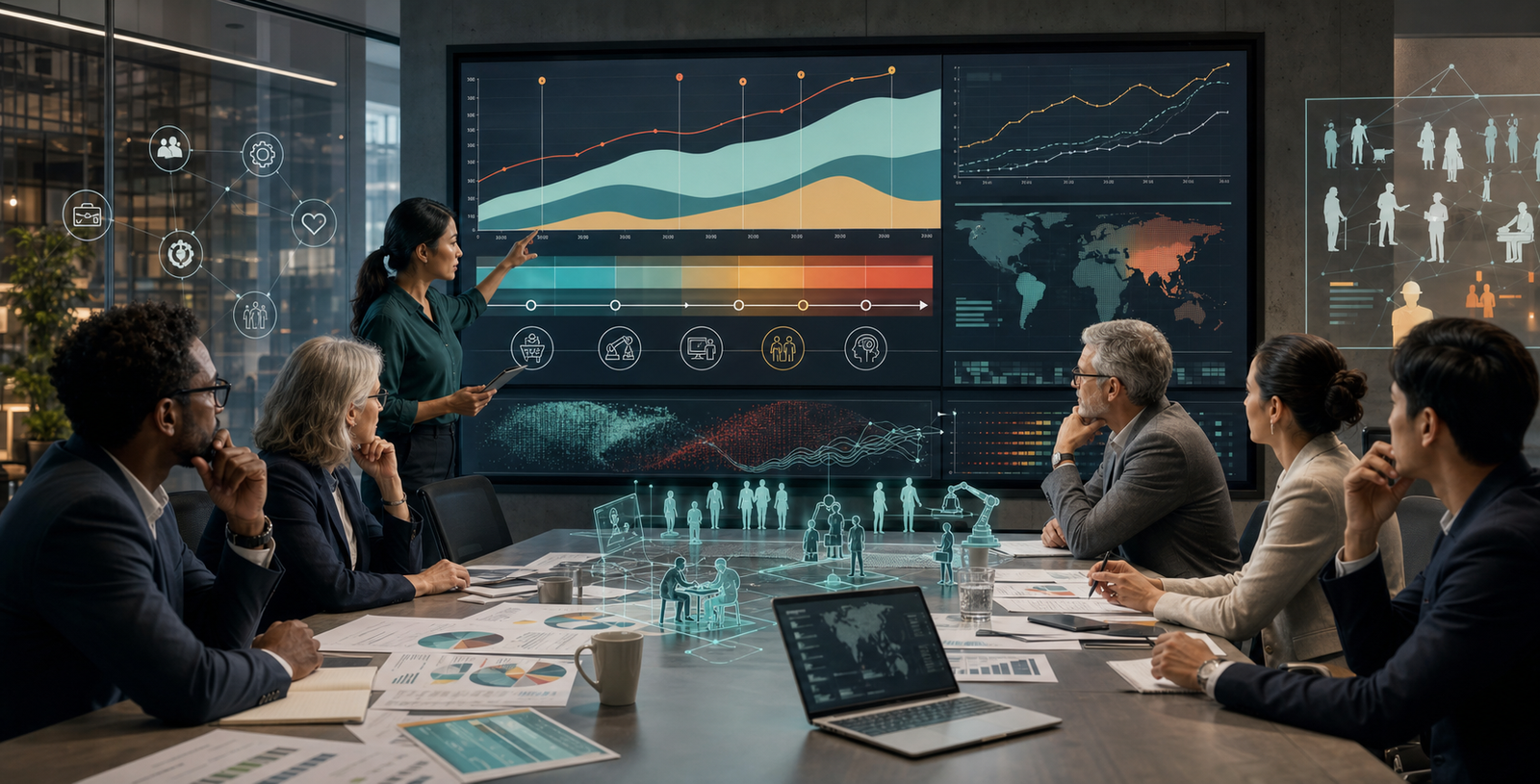
Steam took decades to reshape the economy. Electricity took decades. Even the internet gave societies time to adjust. AI may give us only a few years – and 16 Nobel laureates, along with more than 200 economists and researchers, want governments to start acting like that’s true.
On July 13, 2026, that coalition published a four-sentence open letter that landed like a thunderclap across policy circles worldwide.
What “We Must Act Now” Actually Says
The statement, organized by economists Erik Brynjolfsson, Ajay Agrawal, Anton Korinek, and Tom Cunningham, warns that increasingly capable AI systems could reshape the economy at unprecedented speed.
It calls for three things: deeper research on AI’s economic effects, new policies tailored to those effects, and institutions built specifically to manage the transition. The underlying message is that AI could trigger an economic transformation larger than the Industrial Revolution, but happening far faster, with key risks including large-scale job displacement and key opportunities including major gains in living standards.
The Signatories Make This Impossible to Dismiss
This isn’t a think-tank paper or an academic conference summary. Signatories include OpenAI finance chief Sarah Friar, Google DeepMind Chief Scientist Jeff Dean, Anthropic co-founder Jack Clark, and people on the economics research team at Anthropic. Nobel laureates Michael Spence, Daron Acemoglu, and Simon Johnson, among others, also signed the statement.
That combination – the people building AI and the people who study what economies do under pressure – makes this statement unusual. These aren’t groups that typically sign the same document.
Why the Urgency Is Different This Time
Past technological transformations gave societies room to adapt. Factories displaced agricultural workers, but the shift unfolded over generations. The digital economy reshaped office work, but companies and governments had two decades to write new rules, build new skills, and restructure tax bases.
As Anton Korinek noted, we cannot improvise our strategy and institutions in the middle of the transformation; waiting for certainty means arriving too late.
The AI Researchers Who Build It Agree
What makes the “We Must Act Now” statement different from previous AI warnings is who signed alongside the economists. The presence of researchers from OpenAI, Google, and Anthropic signals that the people with the most direct knowledge of how capable these systems are becoming, and how fast, share the urgency.
Michael Spence, Nobel Laureate and Professor Emeritus at New York University, called for an “all hands on deck” approach to steering AI in beneficial directions, citing the scale, scope, and speed of advances combined with high uncertainty about magnitude and timing of impacts across many parts of the economy.
Three Things the Statement Asks For
The letter doesn’t stop at alarm. It points toward concrete direction. Policymakers are asked to fund serious economic research on AI’s effects – not general AI safety research, but specific work on labor markets, firm behavior, and income distribution. Institutions need to be built now, not retrofitted after the disruption lands.
The statement calls on economists, policymakers, and technology leaders to deepen research on AI’s economic impacts and to begin building the policies and institutions needed to ensure AI complements human capabilities and benefits society.
The signatories also expect the pace of change to accelerate. They expect AI to become radically more powerful over the next 10 years – which means any policy response designed for today’s AI will need to be flexible enough to handle something far more capable.
Conclusion – The Window Is Narrow and the Clock Is Running
Two hundred economists and Nobel laureates don’t write a four-sentence open letter unless the situation feels genuinely urgent. The “We Must Act Now” statement is the clearest signal yet that the economic question around AI is no longer hypothetical – it’s a planning problem with a shrinking timeline.
For workers, businesses, and policymakers, the message is the same: the time to understand what’s coming and start building for it isn’t after the transformation lands. It’s right now, while there’s still room to shape the outcome.
Want to understand what’s driving this urgency from the technology side? Read our breakdown of Nvidia and Hugging Face’s LeRobot open-source push to see how fast physical AI infrastructure is advancing.