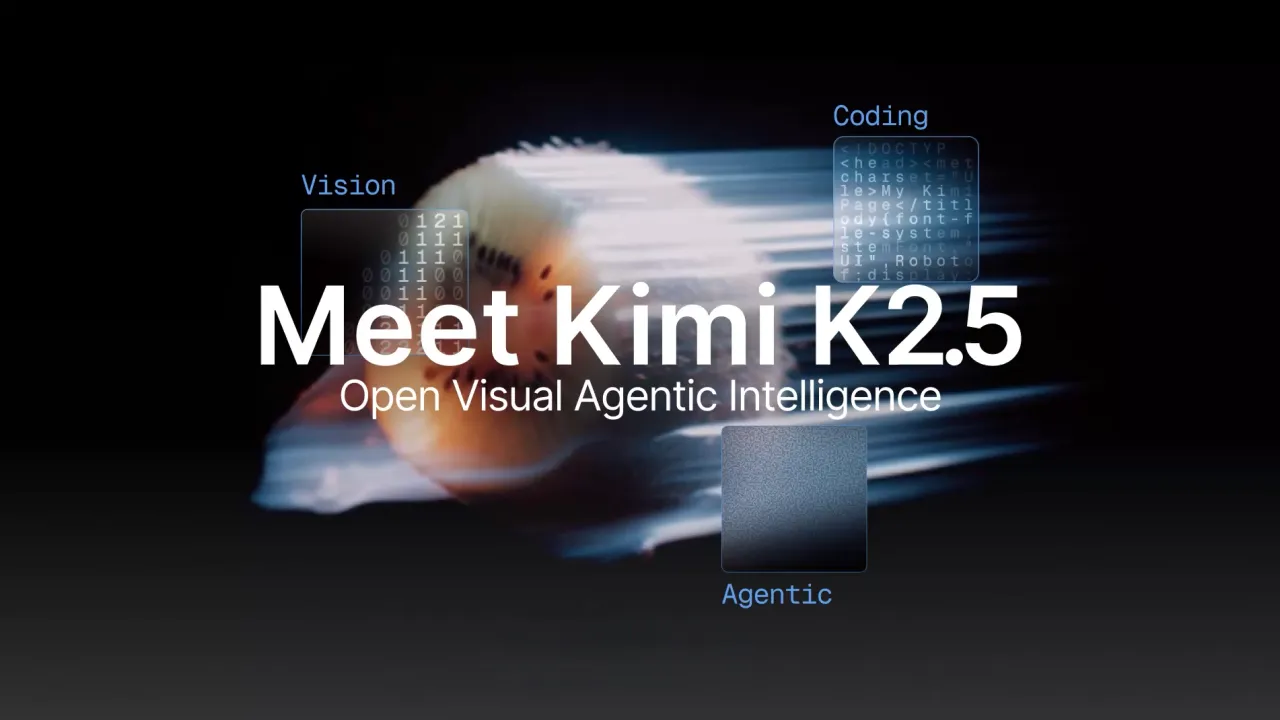
China’s Moonshot AI just dropped one of the most ambitious open-source model releases of 2026 — and the AI community is paying close attention. Kimi K2.5 landed on January 27, 2026 with benchmark scores that challenge the best closed-source models in the world, a genuinely novel approach to agentic workflows, and a release license generous enough to put real teeth behind the “open-source” label. Here’s what it does, why it’s different, and why developers should care.
Kimi K2.5 Is Built for Code, Vision, and Agent Workflows — All at Once
One Model That Replaces Three Separate Tools
Most AI models do one thing well. Kimi K2.5 is designed to do several things well — simultaneously and natively, not through bolt-on adapters.
Kimi K2.5 is an open-source, native multimodal agentic model built through continual pretraining on approximately 15 trillion mixed visual and text tokens atop Kimi-K2-Base. It seamlessly integrates vision and language understanding with advanced agentic capabilities, supporting both instant and thinking modes, as well as conversational and agentic paradigms. The Register
What makes “native multimodal” matter here is the training approach. Vision and coding weren’t combined after the fact — they developed together. That means when you hand K2.5 a UI mockup and ask it to build the interface, it doesn’t treat the image as an afterthought. It reasons over the visual design the same way it reasons over text — and generates production-ready code that actually matches what you showed it.
As a leading coding model, Kimi K2.5 builds upon full-stack development and tooling ecosystem strengths, enabling the generation of fully functional, visually appealing interactive user interfaces directly from natural language, with precise control over complex effects such as dynamic layouts and scrolling animations. Stocktwits
The Agent Swarm Feature Is the Real Story
Up to 100 Parallel Sub-Agents, Working in Coordination
Every major AI lab is building agentic capabilities right now. What Kimi K2.5 does differently is the scale and architecture of how those agents work together.
Agent Swarm technology allows the model to coordinate up to 100 specialized AI agents working simultaneously. Instead of processing tasks one step at a time like most models, this parallel approach cuts execution time by 4.5x while achieving 50.2% on Humanity’s Last Exam at 76% lower cost than Claude Opus 4.5. MLQ
The engineering behind it is novel too. For the Agent Swarm feature, the Moonshot team developed a new reinforcement learning technique called Parallel Agent Reinforcement Learning (PARL), designed to train K2.5 to decompose and parallelize complex tasks. PARL was built to address training instability, ambiguous credit assignment, and “serial collapse” — where an orchestrator simply runs tasks one by one instead of truly parallelizing them. CXO Digitalpulse
In practice, this means a single prompt can spin up a coordinated team of specialist agents — one searching the web, another analyzing data, another drafting output — all working at the same time rather than waiting in a queue.
Benchmark Performance That Challenges Closed-Source Giants
Outperforming GPT-5.2 and Gemini 3 Pro on Key Tests
The benchmarks are where this gets genuinely surprising. In coding benchmarks, Kimi K2.5 outperforms Gemini 3 Pro on SWE-Bench Verified and scores higher than both GPT-5.2 and Gemini 3 Pro on SWE-Bench Multilingual. In video understanding, it beats GPT-5.2 and Claude Opus 4.5 on VideoMMMU — a benchmark that measures how well a model reasons over video content.
LiveCodeBench — which tests up-to-date competitive programming — comes in at 85.0%, while MathVision reaches 84.2% for visual mathematical reasoning. These results reflect consistent performance across image and video inputs without the degradation typically seen in adapter-based multimodal approaches. MLQ
And the release is genuinely open. Model weights and code are publicly available on Hugging Face and the official GitHub repository under a Modified MIT License AI Insider — meaning commercial use is allowed, modification is allowed, and nobody is waiting for an API waitlist. To complement it, Moonshot also launched Kimi Code — an open-source coding agent designed to rival Anthropic’s Claude Code and Google’s Gemini CLI.
Conclusion — A Serious Open-Source Contender, Not a PR Exercise
Kimi K2.5 isn’t a benchmark-farming exercise dressed up as a product release. The combination of native multimodality, Agent Swarm parallelism, competitive coding performance, and a genuinely open license makes this one of the most practically useful open-source model drops in recent memory.
If you build AI-powered applications — particularly anything involving code generation, document workflows, or complex multi-step agent tasks — Kimi K2.5 deserves time on your evaluation shortlist. Pull the weights from Hugging Face, spin up Kimi Code CLI, and see for yourself how it handles your actual workload. The open-source AI race just got a very capable new entrant. 🚀