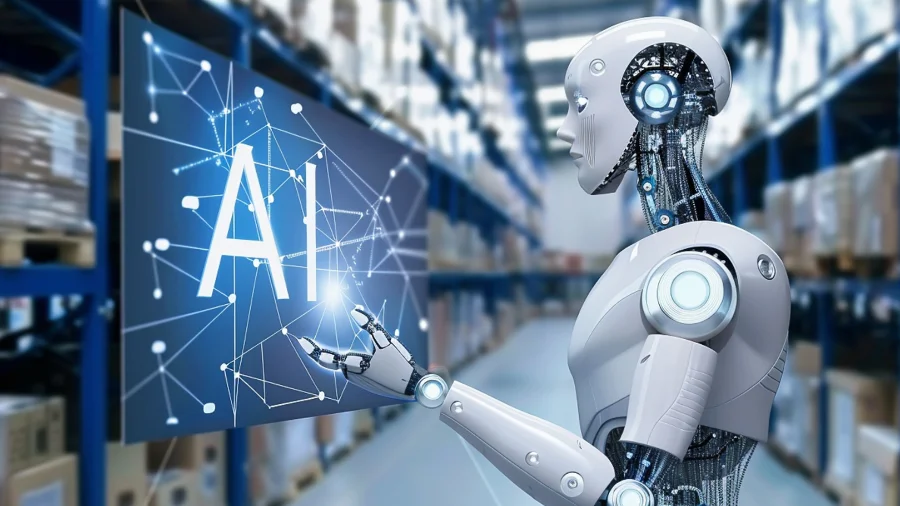
The AI robotics industry just had one of its biggest months in recent memory and March 2026 is already rewriting the rulebook. From a billion-dollar sim-to-reality breakthrough to a Disney robot stealing the show at NVIDIA’s biggest event of the year, the stories coming out right now are not incremental. They’re foundational. Here’s your complete briefing.
ABB and NVIDIA Crack the Simulation-to-Reality Problem
The Bottleneck That’s Held Robotics Back for Decades — Is Gone
For as long as industrial robotics has existed, there’s been a stubborn problem: robots trained in virtual simulations behave differently on the actual factory floor. Lighting, friction, materials, physics the real world is messier than any simulation. That gap has kept AI-powered robots stuck in pilot programs for years.
On March 9, 2026, ABB Robotics and NVIDIA announced a partnership directly addressing this, with ABB integrating NVIDIA’s Omniverse simulation libraries into its Robot Studio platform creating what they call Robot Studio Hyper Reality, claiming up to 99% correlation between simulated and real-world robot behavior.
The technical reason that number holds up is worth understanding. ABB is the only robot manufacturer whose virtual controller runs the same firmware as its physical hardware meaning the simulation and the real machine are speaking the same language, down to the firmware level. ABB claims manufacturers using the technology can cut setup and commissioning times by up to 80% and reduce costs by up to 40% by eliminating physical prototypes with Foxconn already piloting the system for consumer electronics assembly.
NVIDIA GTC 2026: Physical AI Takes Center Stage
From Disney’s Olaf to Global Industrial Partnerships
If you want to understand where AI robotics is heading, NVIDIA’s GTC 2026 event in San Jose was the place to be. The scale of what was announced there is hard to overstate.
NVIDIA unveiled new Cosmos world foundation models, Isaac simulation frameworks, and Isaac GR00T N models to accelerate the transition to intelligent robotics — with physical AI leaders including ABB Robotics, FANUC, Figure, KUKA, Medtronic, Universal Robots, and Agility all building on NVIDIA technology to develop and deploy physical AI at scale.
But the moment that captured everyone’s imagination was unexpected. Disney’s Olaf robot made a live appearance at Jensen Huang’s GTC keynote, trained using NVIDIA’s Warp-based Kamino simulator — allowing Olaf to learn to manage its own heat and reduce impact noise while navigating complex environments, ahead of his debut at Disneyland Paris on March 29.
It sounds like a fun PR stunt. Watch the technical demo, though, and it becomes clear it’s actually a proof of concept for how simulation-trained robots handle unpredictable real-world conditions — disguised as entertainment.
The Market Is Moving Fast and the Money Is Following
Mind Robotics Raises $500M, and Costs Are Set to Plummet
Investment is accelerating at a pace that signals genuine conviction, not just hype. Mind Robotics — a company spun out of electric vehicle maker Rivian — raised $500 million in a Series A round co-led by Accel and Andreessen Horowitz, bringing total funding to $615 million and valuing the company at roughly $2 billion. AI Insider The focus: factory robots with human-like dexterity for tasks traditional automation simply can’t handle.
Meanwhile, the cost trajectory for humanoid robots is changing the entire addressability conversation. The Bank of America Institute projects that the material costs of a humanoid robot could fall from $35,000 in 2025 to between $13,000 and $17,000 by 2035 WinBuzzer — a price point that shifts the question from “can a Fortune 500 afford this?” to “which mid-sized manufacturer moves first?”
The global market value of industrial robot installations has already reached an all-time high of $16.7 billion, with the International Federation of Robotics identifying AI-driven autonomy, IT/OT convergence, and humanoid deployment as the three forces shaping what comes next. CXO Digitalpulse The numbers and the strategic direction are pointing the same way — forward, fast.
Conclusion The AI Robotics Era Isn’t Coming. It’s Here.
March 2026 didn’t just deliver impressive headlines. It delivered proof. The sim-to-real gap is closing. The platform ecosystem is maturing. The capital is flowing. And the companies building this technology — from NVIDIA to ABB to Google DeepMind — are moving with the urgency of people who know the window for competitive advantage is narrow.
AI robotics is no longer a story about what might be possible. It’s a story about what’s being deployed right now, in factories and warehouses and theme parks and airports around the world. Whether you’re an investor, a developer, or simply someone paying attention to how the world is changing — this is the story to follow in 2026. Don’t fall behind.