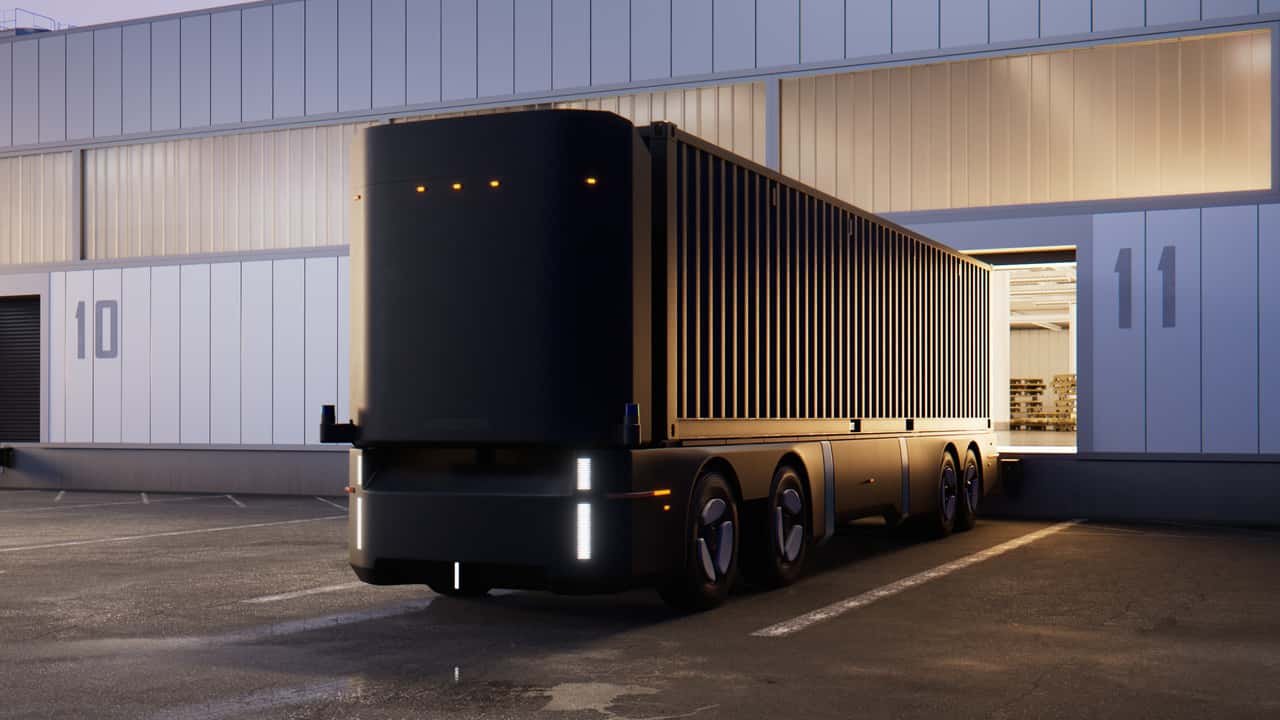
An elegant, modern cables electric freight hauler called the Humble Hauler that can drive independently through busy ports or warehouse yard equipped with cameras and sensors that are in view, amidst an industrial-style backdrop that is clean and crisp with subtle electric-blue and green lighting to communicate the sustainability and ingenuity.
The industry of freight just experienced the most radical disruption it has ever had. Humble is an SF-based startup is emerging from the shadows with the funding of $24 million for its seed round as well as a fully autonomous electric vehicle that is wired to redefine the rules of logistics.
No driver. No taxicab. No compromise.
What Is the Humble Hauler? Meet the Cabless Electric Freight Revolution
The core of Humble’s launch is Humble Hauler –an electric, battery-powered class 8 freight platform built from scratch with no traditional driver’s cab.
This isn’t a minor change. It’s a complete change.
Why Removing the Cab Changes Everything
Most autonomous trucking firms retrofit their tractor-trailers with self-driving software. Humble chose a different approach: a clean-sheet design in which the absence of cabs is an advantage rather than an oversight.
Without an cab it can provide 360 degree sensor coverage with cameras, radar and LiDAR — which allows precise, autonomous navigation in challenging logistics settings such as rail yards, ports and warehouse facilities.
This also signifies less weight, higher payload efficiency, and less maintenance costs in comparison to traditional tractor-trailers. The CEO and co-founder Eyal Cohen stated it in a simple way: “Trucks were never designed to be completely autonomous. ” Humble is building one that is.
$24M Seed Round: Who’s Betting on Humble?
The round of funding was managed by Eclipse Ventures — the Palo Alto-based firm which has established physical AI as its primary investment premise, with the participation of Energy Impact Partners and other investors.
A Founder With Deep Autonomous Vehicle Roots
Eyal Cohen isn’t the first founder to experiment with technology. His 20-year career spans Apple, Uber ATG and Waabi as well as he was the co-founder of Spark AI which was acquired by John Deere in 2023. He has brought the credibility of an autonomous vehicle to a concept that is already ambitious.
Investors are also bullish on the angle of capital efficiency. Eclipse Partner Lior Behl has noted that the scaling and deployment of a pilot system for the Hauler will not require one billion dollars, suggesting that the cables and purpose-built system could be much less expensive to commercialize as compared to full-highway automated trucking technology.
The Market Opportunity: A $906 Billion Industry Ready for Disruption
The numbers that explain Humble’s timing are difficult to ignore.
U.S. trucking is an $906 billion sector. Its autonomous segment is estimated at $575.7 million by 2026. The figure will likely to hit $3.25 billion before 2035which is a huge growth track for the first moving companies.
Regulatory Tailwinds Are Arriving
The federal momentum is growing in parallel. It is the Self Drive Act 2026 which was first presented in February, proposes the creation of a federally-unified system for autonomous truckingan opportunity to transform the game for companies such as Humble that are navigating a plethora of state-specific rules.
Cohen has been interacting at length with representatives from the National Highway Traffic Safety Administration (NHTSA) as recently as last week and Humble has maintained contact with the organization since its inception on in the process of developing. This relationship could be crucial when the company is moving towards commercialization.
The Hauler’s initial focus is at tightly controlled, semi-controlled settings – railway yards, ports and warehouse facilities in which predictability is more high and regulatory complexity is less. Humble claims that its solution will be one of the the first class 8 solution that can unload directly from the dock without the intervention of a human which distinguishes it from competitors such as Aurora (hub-to-hub) as well as Kodiak (fixed areas for launch).
Conclusion — Is Humble the Future of Zero-Emission Freight?
Humble’s rise is a clear indication that the next phase of autonomous trucking won’t just be just about attaching sensors to older trucks, but will be about redesigning what the car is actually doing.
With $24 million in the bank and a clean-sheet electronic platform and founding who has spent the last 20 years working in the autonomous vehicle market, Humble is positioning itself at the crossroads of three major trending areas: electrification, automation and efficiency in logistics.
The commercial schedule or pilot companies haven’t yet been announced yet, but the direction is clearly defined. If you’re looking for what’s coming for freight in the near future, keep your eyes on Humble..