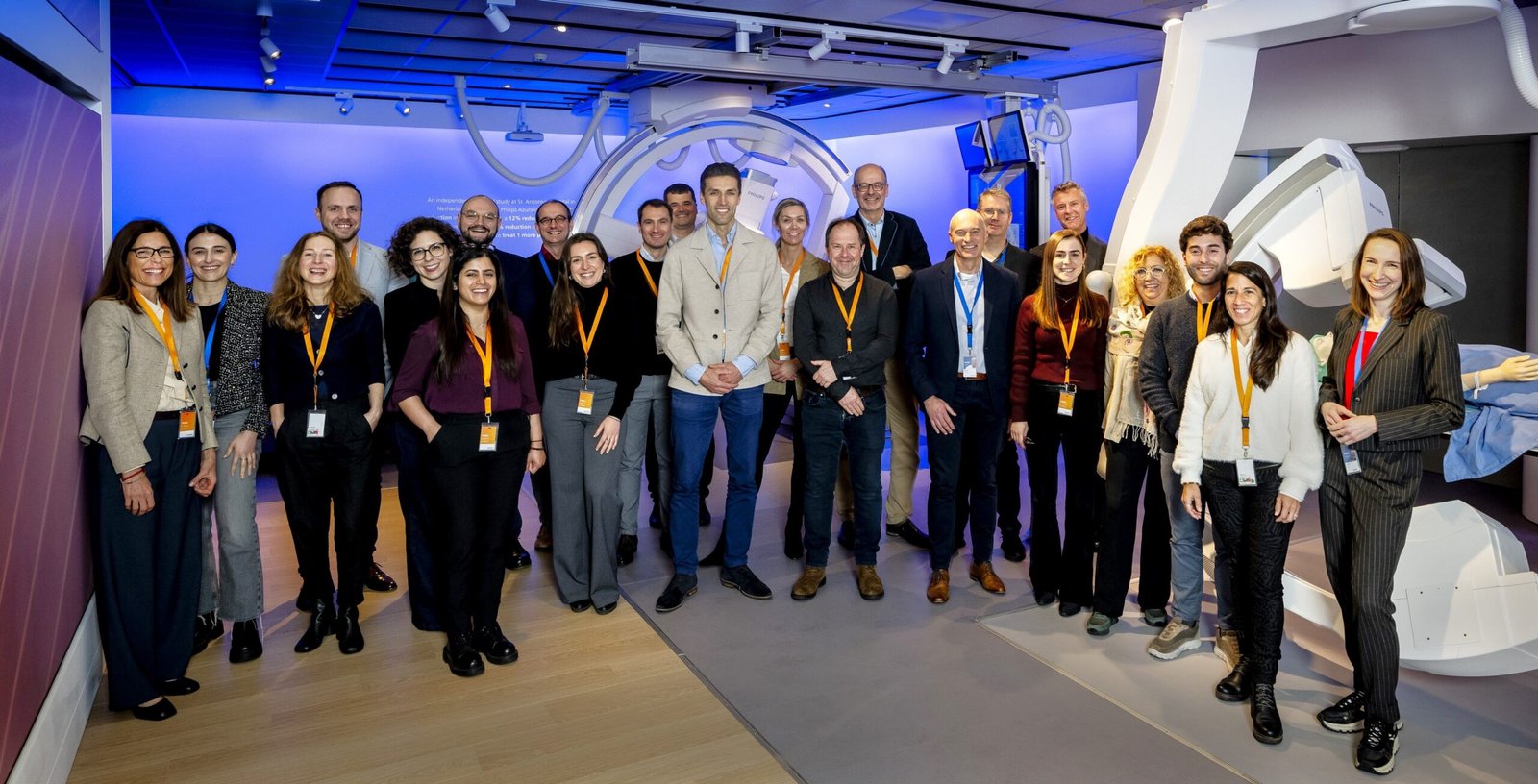
When a European research consortium backed by Philips, Medtronic, and the EU launches seven simultaneous clinical studies to validate AI in some of medicine’s most complex procedures, it’s worth paying attention. The SHERPA research consortium announced in March 2026 that it has formally initiated clinical trials testing AI-assisted workflows for brain aneurysm repair and liver tumor treatment bringing a technology that’s long been discussed in labs directly into operating rooms. Here’s what’s happening, and why it matters.
What Is SHERPA and Why Does It Exist?
A Physician Shortage Is Forcing a Smarter Solution
The name is intentional. SHERPA Smart Human-centred Effortless support for Professional clinical Applications is designed to be exactly what the name suggests: a reliable guide for physicians navigating some of the most technically demanding procedures in medicine.
The World Health Organization has projected a shortfall of 600,000 physicians in the European Union by 2030, with interventional radiology among the most affected specialties. AI Insider These are the specialists who perform minimally invasive procedures inside blood vessels and organs threading catheters through arteries to repair brain aneurysms, or using imaging guidance to ablate tumors without open surgery. The procedures are extraordinarily complex and the specialists who perform them are in short supply.
Staff shortages, coupled with the complex nature of the work, place significant pressure on interventional radiologists and interventional neuroradiologists. The SHERPA consortium aims to validate AI-powered technologies in imaging, data visualization, procedure planning and guidance, clinical decision support, and patient pathway orchestration designed to automate repetitive tasks, support decision-making, and accelerate learning to ease the workload.
The Seven Studies: What’s Actually Being Tested
From Brain Aneurysm Detection to Robotic Lung Biopsies
This isn’t theoretical research. These are active clinical studies running right now across leading hospitals in the Netherlands, Germany, France, and Spain. Five studies focus on brain aneurysm treatments and two address liver and lung tumors.
The brain aneurysm studies include RADAR an AI tool that detects aneurysms from CT and MRI scans and Aneurysm@risk, which uses algorithms to predict whether an aneurysm is likely to grow or rupture, one of the most difficult judgments a neuroradiologist makes. ASSIST tests AI-supported device selection and positioning guidance during procedures. INTERACT evaluates automatic imaging optimization during live procedures. And SAFO tests a digital remote follow-up solution for patients recovering after treatment.
On the cancer side, MISTRAL evaluates new Cone Beam CT imaging workflows for liver tumor ablations, while RHODES compares robotic-assisted versus free-hand lung biopsies focusing on precision, operability, and device efficiency.
Together, these studies will measure real-world impact on patient outcomes, physician workload, procedural precision, and satisfaction not just laboratory benchmarks.
The Partnership Behind It and What Makes It Credible
€21.5 Million, 16 Partners, Seven Countries, Four Years
Scale and credibility matter enormously in clinical research and the SHERPA consortium has both. The €21.5 million project is co-funded by the European Union’s Innovative Health Initiative and industry partners, with 16 partners across seven European countries spanning medical technology firms, academic hospitals, and research organizations. Industry partners include Philips, Medtronic, Sim&Cure, Interventional Systems, and Barco.
Academic partners include some of Europe’s most respected medical centers University Medical Center Utrecht, University Medical Center Hamburg-Eppendorf, Hôpital Bicêtre AP-HP in Paris, and Hospital de la Santa Creu i Sant Pau in Spain. During the first year of the project, the consortium already successfully developed AI algorithms for brain aneurysm detection and risk prediction, therapy planning for liver tumor ablation, robotic technology for improved precision, and AI software to confirm treatment success all now integrated into end-to-end clinical workflows.
This isn’t a project still searching for a use case. The tools are built. The trials are running. The question now is how well they perform under real clinical conditions.
Conclusion This Is What Responsible AI in Healthcare Looks Like
The SHERPA consortium represents exactly the approach that AI in medicine needs more of: rigorous, multi-site, EU-funded clinical validation before widespread adoption not deployment first, proof second. The fact that seven simultaneous studies are running across five countries, testing AI across the full spectrum of a clinical procedure, signals that this technology is being taken seriously at the highest levels of European healthcare.
The results of these trials, expected to emerge over the next three years, will directly shape how AI-assisted workflows are adopted or not in interventional radiology across Europe and beyond. For patients, physicians, and healthcare systems grappling with staff shortages and rising procedural complexity, the stakes couldn’t be higher. Watch this space.